No Asteroids Air and Oxygen: How to Never Black Out
How the No Asteroids air bar works, what a blackout costs, when to turn back, what the ampoule is worth and how the jetpack and tether keep you alive.
Air is the only bar in No Asteroids that punishes you for emptying it. Cargo just stops accepting ore. Charges just run out. Air takes your hold and one of your ninety days. The good news is that the air bar is also the most predictable system in the game: it drains at a steady rate while you are outside, it does not care how deep you are, and the return trip costs roughly the same fraction it cost last time. Learn that fraction and blackouts become rare.
Does air measure depth or time?
Time. Air drains while you are outside the lander, whether you are chipping at the surface or boring a deep shaft, so depth only matters because it takes longer to get back. A shallow dig with a long detour can cost more air than a deep one with a straight route home.
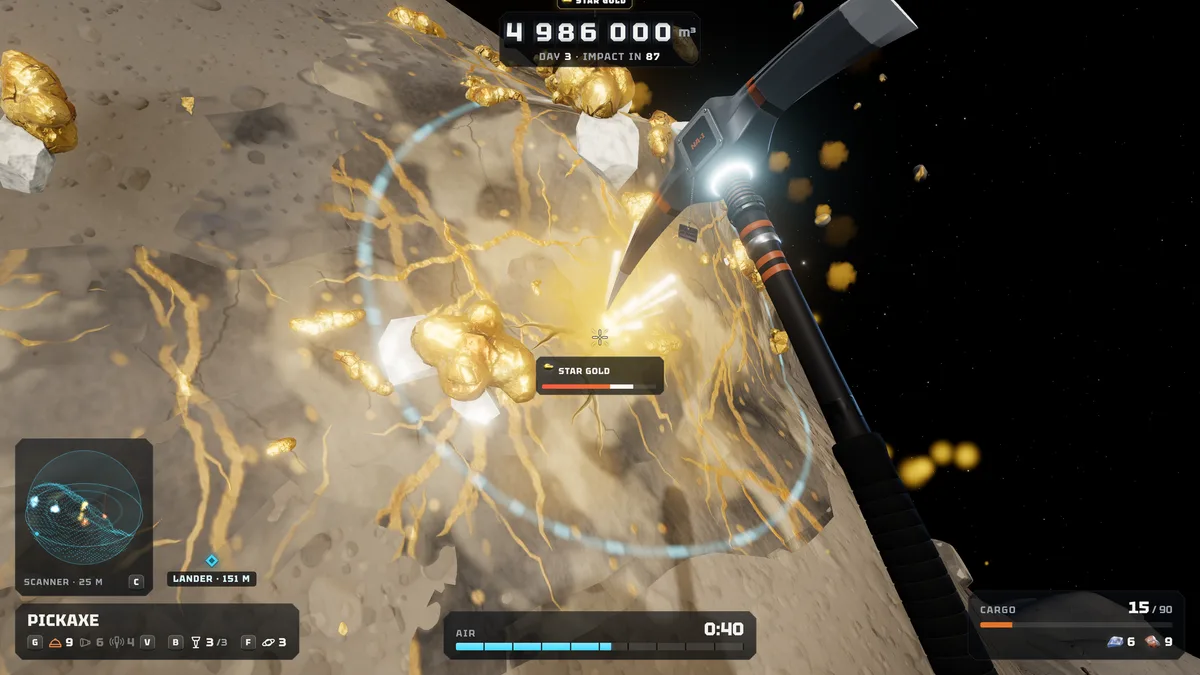
That is why the useful mental model is a return ticket rather than a fuel gauge. The bar is not telling you how much digging is left; it is telling you how much time you have before the trip home becomes impossible. Once you start reading it that way, the route decisions get simpler.
What does a blackout actually cost?
Your cargo and the day. When the bar hits zero you black out, the ore you were carrying is lost, and the in-game day is spent. You keep the ship, every tool, every upgrade and every ship module, so a blackout never ends a run — it just removes one-ninetieth of the contract and everything you were carrying when it happened.
There is a second cost that is easier to miss: the ore is still on the asteroid. You do not get to fly back down and pick it up, because the day has advanced and the shift is over. A blackout on a high-value haul is therefore worse than a blackout on a bulk haul, even though the day cost is identical.
When should you turn back?
At about a quarter of the bar. That is the conservative rule, and it is deliberately so: a quarter bar covers the flight home plus the walk from your cut face back to the lander, with enough margin for a wrong turn or a gas pocket knockback. If you are new, use half a bar until you know how long your own return takes.
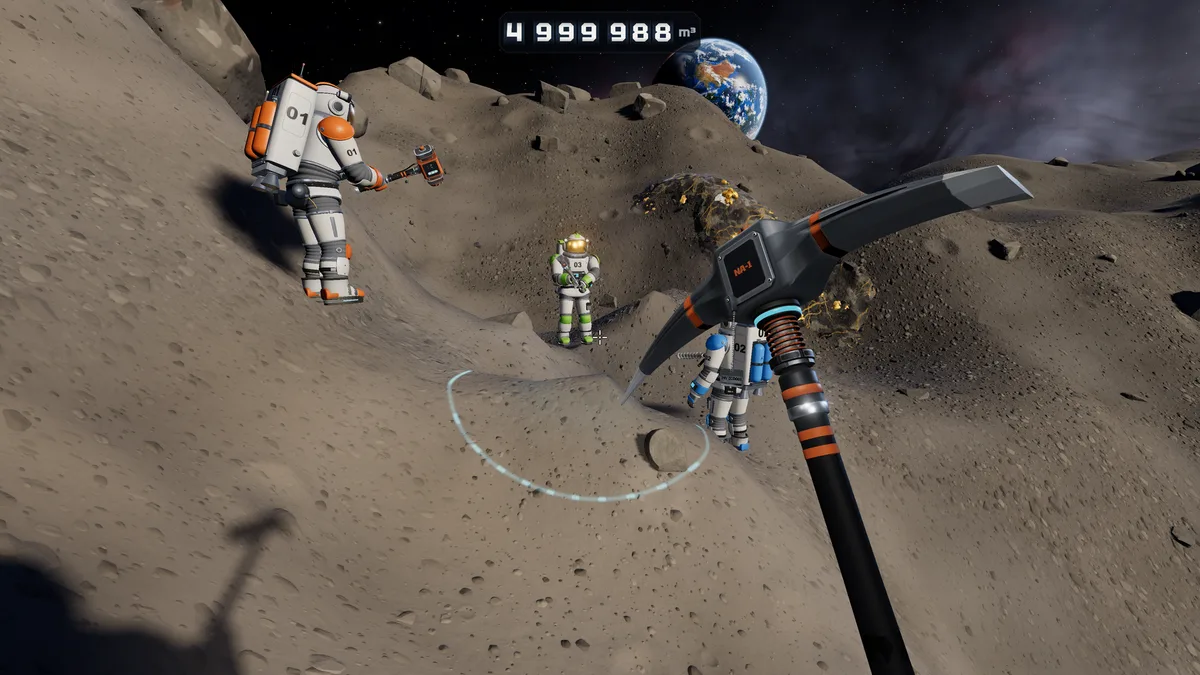
There is a second number worth holding alongside it: do not plan a dig that needs more than about a third of your remaining air to get out of. That is the route rule from the mining routes guide, and it is a ceiling rather than a target — a quarter bar is where you leave, a third is where you should never have gone.
Do air tank upgrades really double a shift?
Community-reported testing says an air upgrade roughly doubles the time you can spend outside, which is the single biggest quality-of-life jump in the early game. Treat the “roughly double” as a player measurement from the launch build rather than an official multiplier, and treat the price as a quote rather than a rate: the game does not publish air upgrade costs, so the terminal tells you what it costs on the day.
The reason the upgrade is so strong is that it compounds with cargo. More air means a longer shift; a longer shift with the same cargo cap just means you fly home full instead of half full. That is why air comes first in the default purchase order, and why buying cargo before air tends to produce a hold that fills at the same moment the bar empties.
| Your situation | Turn back now? | Why |
|---|---|---|
| Bar at a quarter | Yes | The return trip is the one thing you cannot skip |
| Bar at a third, deep cut, unfamiliar route | Yes | Unknown tunnels eat margin |
| Bar at half, cargo full | Yes | A full hold is a finished shift |
| Bar at half, empty hold, ore in sight | Stay, but mark the exit | One more pocket is affordable if the route home is known |
| Bar below a quarter with a gas pocket between you and the lander | Yes, via another route | Knockback can cost the margin you were relying on |
| Ampoule in hand, bar empty | Head home immediately | Fifteen seconds is an exit, not a shift |
How much air does the ampoule give?
Fifteen seconds, once per in-game day. You collect it from the first-aid box before the descent, and it triggers when your bar is already empty — so it does not extend a normal shift, it buys you a short second wind at zero. You cannot carry two, and picking it up commits it to that day.
Fifteen seconds is roughly enough to finish a cut and start moving, or to cross a short gap to the tether line. It is not enough to explore, and it is not a substitute for turning back on time. The Second wind achievement, held by 10.8% of players at the time of writing, is what you get for using it; the achievement is a record of a rescue, not a strategy.
Is second wind a plan?
No. Second wind is what happens when the plan fails. Building a route around the ampoule means building a route that ends with an empty bar, and an empty bar at the bottom of a shaft is a blackout the moment the fifteen seconds run out. Use it to recover from a surprise — a gas pocket knockback, a wrong turn, a pocket that took longer than expected — not to extend a shift you already know is too long.
The same logic applies to the air upgrade. Buying a bigger tank does not make the quarter-bar rule obsolete; it makes the quarter bar represent more real time. The rule scales with the tank.
Jetpack or tether: which gets you home?
Both, in different jobs. The tether, on R, pulls you back toward the lander and is the only fast travel in the game. The jetpack is for climbing out of the hole you made, and since 1.0.8 it recharges in mid-air, which removed the old problem of running dry halfway up a shaft. Upgraded boots can also anchor you to the asteroid, one of the launch-week additions.
| Situation | Use | Reason |
|---|---|---|
| Lost in a tunnel network | Tether | It pulls toward the lander regardless of the route |
| At the bottom of a vertical shaft | Jetpack | The tether cannot lift you out of a hole you cannot see out of |
| Carrying a full hold, short of air | Tether | Fastest way to convert air into distance |
| Working a steep face | Anchored boots | Keeps you in place without spending air on corrections |
| Returning to a cut after a resupply | Jetpack | Faster than walking the tunnel again |
The scanner and tether guide covers the pair in more detail. For air purposes, the rule is that the tether is free insurance and the jetpack is a tool you have to learn — so build routes that end within tether range, and use the jetpack to make the route shorter.
What is the co-op air risk?
The launch countdown. Anyone seated in the lander can start a 10-second countdown, and anyone outside when it finishes blacks out and loses their cargo. In solo play you are always the one deciding when to leave; in co-op, a crewmate who is ready to go can end your shift for you.
The fix is social, not mechanical. Agree that nobody starts a countdown without a headcount, call your status when you are below a quarter bar, and treat “coming up” as a commitment rather than a hope. Our co-op guide has the full set of crew rules, including the host’s kick and rejoin controls.
Which hazards eat air fastest?
The gas pocket and the Antimatter blast. Breaching a gas pocket hurts and knocks you back, and while the knockback fades with distance since 1.0.2, the seconds lost to the stumble come straight out of your return margin. Antimatter is worse: cutting it with a hand tool or drone detonates it, and community measurement puts the blast at 3.4 m with roughly eight seconds of air lost if you are inside it. Break Antimatter with a charge, singularity, mining rig or ship gun instead, and it drops without a blast. The hazards guide lists every safe method.
Both hazards are survivable if you keep the quarter-bar rule. They are lethal when you meet them at a tenth of a bar with a full hold, because the knockback and the lost seconds convert a tight return into a blackout. If the beginner guide gave you one habit, make it this one: the air bar is a return ticket, and the asteroid will still be there tomorrow.
Gallery
FAQ
How long does the air bar last in No Asteroids?
Do air tank upgrades double shift length?
Can I save the emergency ampoule for another day?
Does blacking out end my run in No Asteroids?
Related Articles
guides
No Asteroids Beginner Guide: Your First Three Shifts
A No Asteroids beginner guide to the first three shifts: the 90-day contract, air and cargo limits, the tether, the ampoule and what to buy first.
guides
No Asteroids Tips: 15 Habits That Save In-Game Days
Fifteen No Asteroids tips that actually save time: quarter-bar returns, cargo before speed, daily bonuses, gun timing and the habits that prevent blackouts.
mining
No Asteroids Mining Routes: How to Dig and Get Back
A practical No Asteroids mining route: plan the exit first, spiral instead of sinking a shaft, watch the one-third air rule, and know when to tether home.
Was this helpful?
Thanks for the feedback!