No Asteroids Drones: Digger, Prospector, Sapper and More
The four No Asteroids drone kinds, the 17.4 m Antimatter standoff, the +25% power upgrades, and how to judge whether a drone earns its price.
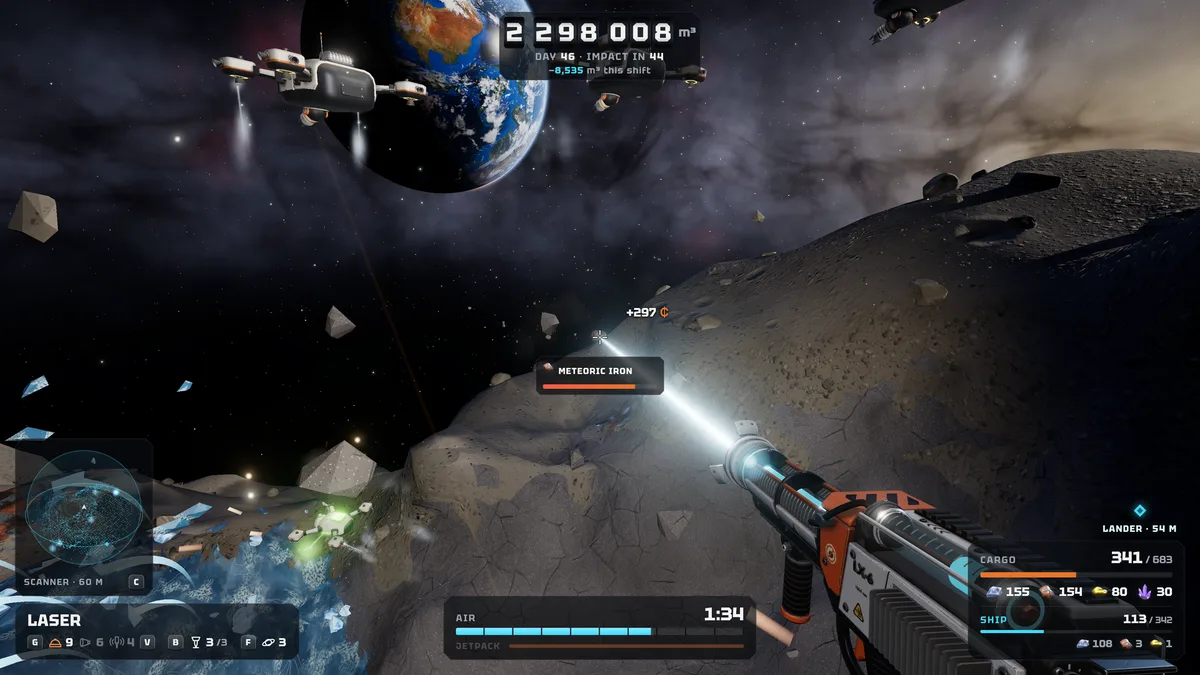
A drone is the only upgrade in No Asteroids that keeps earning while you are doing something else. That is the whole case for buying one, and it is also the reason the four kinds are not interchangeable: each one replaces a different part of your attention, and buying the wrong one gets you a machine that duplicates work you were going to do anyway.
This page covers all four kinds, the numbers that shape how they behave, and the point at which a drone stops being a luxury.
What are the four drone kinds in No Asteroids?
The four are the Digger, the Prospector, the Sapper and a fourth kind that completes the set. The first three have clearly described roles — excavation, ore finding and explosives — and the fourth is counted by the “Squadron” achievement even though the published material does not spell out its job.
| Drone | Role | What to know |
|---|---|---|
| Digger | Excavates areas and seeks out rock | The volume machine; send it at a face, not at a seam |
| Prospector | Finds ore | Keeps 17.4 m clear of Antimatter, which makes it the safe scout |
| Sapper | Handles explosives | The one to pair with a charge-heavy shift |
| Fourth kind | Not described in published material | Counts toward Squadron; check the workshop description in-game |
The important structural point is that drones work independently. You do not steer them; you point them at a problem and go back to your own swing. That is what separates them from the hand tools and from the ship guns, which fire on their own but only at whatever the ship can see.
What does the Prospector’s 17.4 m standoff actually mean?
It means the Prospector will not touch Antimatter, and the distance is generous on purpose. The blast radius on an Antimatter block is 3.4 m, so 17.4 m is roughly five times the danger zone — enough that a Prospector working a seam will stop well before a mistake could cost you the ore and eight seconds of air.
That standoff is the single most useful number in the drone system, because it tells you which drone to send where. A seam with Antimatter in it is Prospector country: the machine finds the ore, declines the hazardous block, and leaves the dangerous part for you and a charge.
The published material only gives the Prospector this rule. If you send a Digger into a seam you suspect is hot, treat it as unprotected — the Digger’s job is to excavate, and excavation is exactly the kind of cut that sets Antimatter off.
Do drones set off gas pockets?
Not near you, since 1.0.2. The patch added a rule that drones avoid opening gas pockets close to the player, which removed the most annoying version of the hazard: a machine quietly venting a pocket into the tunnel you were standing in.
The rule is about proximity, not about the asteroid as a whole. A drone working a distant face can still open a pocket, and you can still walk into one yourself. The hazards guide covers what a breach does to you and why distance is the only defence.
For planning purposes, the 1.0.2 change means drones went from a liability in gassy rock to a reasonable choice. That is a bigger shift than it sounds, because gas pockets are common enough that most deep routes run into one.
How do drone power upgrades work?
Each level adds 25% power, and the upgrade was formalised in 1.0.4. Power is the stat that decides how fast a drone does its job, so a few levels change a drone from a slow helper into something that keeps pace with your own tool.
The 25% is per level rather than a flat bonus at a threshold, so power climbs with each purchase instead of jumping all at once. That is why the first upgrade on a drone you use every shift is usually better value than a second drone you use occasionally: the machine you already trust gets better at the job it is already doing.
Prices for the drones themselves and for their upgrades are not published in the material we can verify, so the only honest way to plan them is by what they replace: a drone that excavates for you is worth roughly the air you would have spent doing that excavation by hand.
Do drones work in co-op?
Yes, and each guest brings their own. Since 1.0.1 every player in a crew has their own drones rather than sharing the host’s, so an eight-player crew can have machines working several faces at once.
The economy around them is still shared. Ore goes into one wallet, and the host controls spending, so a guest buying drone upgrades is spending the crew’s money. If your group has a rule about who buys what, drones belong in it — a guest who spends the shift’s profit on a second Digger has made a decision for everyone.
Crews also get a specific benefit from the Sapper. Explosives are a bigger part of a co-op shift because more people means more faces being opened at once, and a drone that handles charges for you lets you keep swinging while the blasting happens. Our co-op guide covers the rest of the crew-level rules, including the countdown that catches players underground.
When does a drone pay back?
When it is doing work you would otherwise do with your own air. That is the test, and it is stricter than it sounds.
A Digger pointed at a wall you were about to mine does not save you anything — it duplicates you. A Digger pointed at a wall you were going to skip saves you the whole trip. The same logic applies to the Prospector: it pays back when it finds a seam you would have missed, not when it confirms a seam you were already standing on.
The second condition is route shape. Drones are independent, which means they are at their best on a shift where you have two jobs and one body. If your route is a single straight tunnel and you never turn your back on the face, a drone has nothing to do that you are not already doing.
The third condition is the phase of the run. Early on, ore money is short and air is the bottleneck, which makes an air upgrade the better buy. Once your shift length is comfortable and your problem is volume rather than survival, drones start to make sense.
Which achievements track drones?
Two. “Little helper” is awarded for your first drone and sits at 85.5% of players at the time of writing, so it is one of the earliest achievements most runs pick up. “Squadron” is awarded for owning all four kinds and sits at 59.5%.
That gap is informative. Roughly a quarter of players who buy one drone never buy the set, which is consistent with the fourth kind being the odd one out — the three described drones each solve an obvious problem, and the fourth does not advertise one. If you are chasing Squadron, buy the fourth kind deliberately rather than waiting for a reason to.
The achievements list has the full breakdown if you want to see how the drone achievements compare with the tool and weapon ones.
Drones are one part of a shift that also includes charges and a route plan. The charges guide explains why the Sapper pairs with a charge-heavy loadout, and the all tools guide covers the hand-tool ladder those drones are working alongside.
Gallery
FAQ
How many drone types are in No Asteroids?
How close can the Prospector get to Antimatter?
Do drones trigger gas pockets?
Are drones shared in co-op?
Related Articles
tools
No Asteroids Tools: All 6 Hand Tools Ranked and Explained
Every No Asteroids hand tool in order, from the Pickaxe to the Lance and Slicer pair: what each tier costs, what it changes, and when to skip it.
tools
No Asteroids Charges: All 5 Explosives and When to Use Them
The five No Asteroids charge types, the 12-to-24 carry limit, what the Shaker actually does, and why a charge is the safe way to break Antimatter.
tools
No Asteroids Scanner and Tether: Reading the Rock
How the No Asteroids scanner shows ore through rock, what the per-mineral colours mean, and when the R-key tether is cheaper than walking out.
Was this helpful?
Thanks for the feedback!