Is No Asteroids Worth It? A Launch-Week Review Roundup
Is No Asteroids worth $7.99? A launch-week look at the Very Positive reviews, what players praise, what they criticise, and who should wait for a patch.
Launch week is the worst time to be certain about a game and the best time to be specific. No Asteroids has enough reviews to show a pattern, enough patch history to show the developers are responsive, and a price low enough that the usual “wait for a sale” advice needs a real argument rather than a reflex. Here is what the launch-week evidence supports, and where it runs out.
Is No Asteroids worth it at launch?
Yes, for the right player, at $7.99. The game holds a Very Positive rating from roughly 1,294 reviews on 28 November 2026, four days after release, and the main contract runs about 6 to 9 hours. That is a fair amount of game for the price even if you never touch New Game Plus, and the loop is unusual enough to be worth trying if the idea of grinding an asteroid appeals.
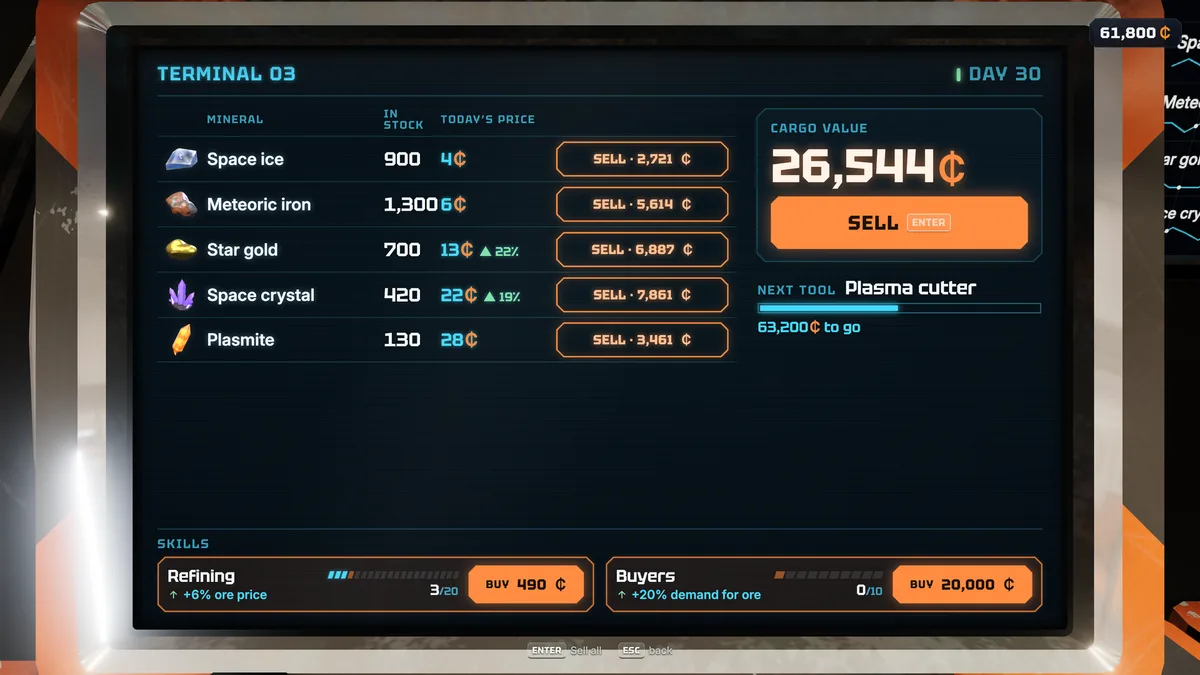
The “right player” caveat is doing real work. No Asteroids is a repetition game: you dig, you sell, you upgrade, and you do it again ninety times. The satire and the ship life are the variation. If that structure sounds like a chore, the positive reviews will not save it for you, and the negative ones will describe exactly why.
How is the game reviewed?
Very Positive, with about 1,294 reviews on 28 November 2026. SteamDB recorded an all-time peak of 14,560 concurrent players on 25 November, and the game had 100,000 wishlists before launch. Those are healthy launch numbers for a $7.99 indie, and they matter for a different reason than quality: a populated launch means the co-op mode has people to play with and the leaderboards have times on them.
Treat every one of those figures as a snapshot. Review counts change hourly, concurrent peaks are a launch-week artefact, and the rating can move once the first wave of players reaches the back half of the run — which is exactly where the criticism concentrates.
What do players praise?
Three things come up repeatedly in the positive reviews: the loop, the satire and the value.
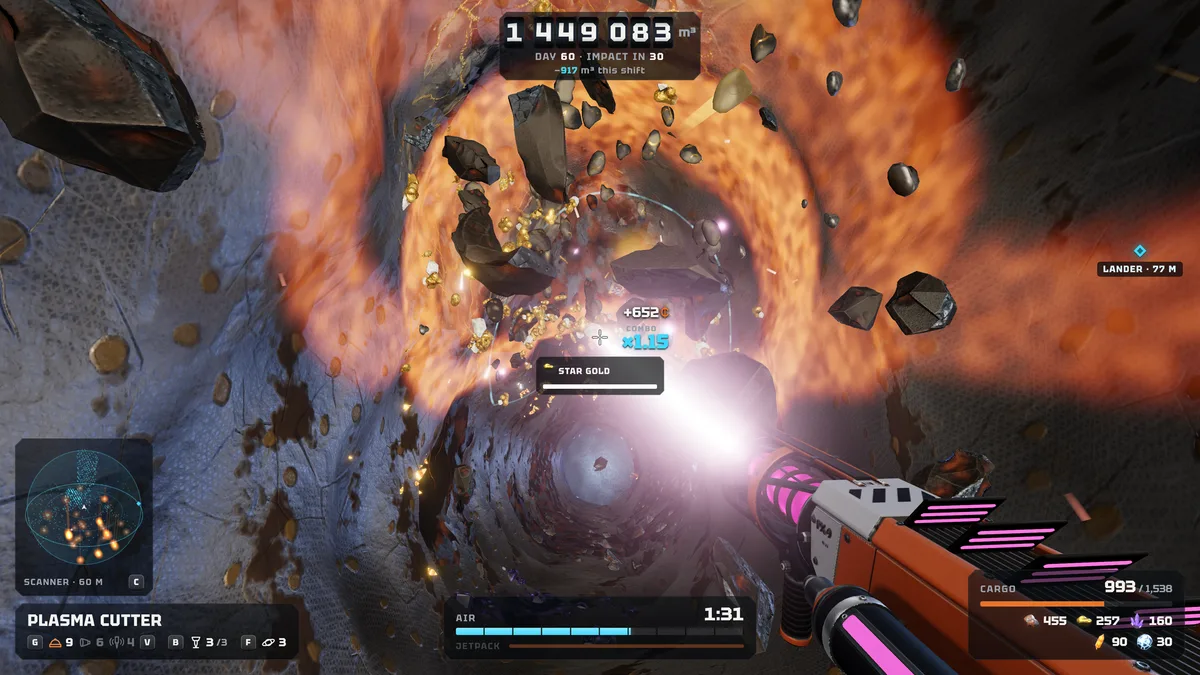
The loop is the strongest. Dig, sell, upgrade is a well-worn structure, but No Asteroids makes it tactile: the air bar forces a decision on every shift, the tether gives you a panic button, and the terminal turns a hold into a purchase within seconds. Players describe losing an evening to “one more shift” in the way that good loop games earn.
The satire is the surprise. The framing is a government contract to save Earth, and the ship is full of jokes about it: a museum of asteroid defence budgets, a telescope with vignettes, betting on your own run, a post-campaign client that wants a duck-shaped asteroid removed. It is dry rather than loud, and the reviews that mention it tend to mention it fondly.
The value is the simplest. $7.99 for a 6 to 9 hour contract, with co-op and New Game Plus on top, is a low price for the genre. The how long to beat breakdown does the arithmetic; the short version is that the price is not the risk.
What do players criticise?
Four complaints recur.
Repetition in the back half. The loop does not change much after the core, and the rock gets harder rather than more interesting. It is the most common criticism, and it is structural rather than a bug.
Tight air early. Many new players black out repeatedly in the first week because the air bar is unforgiving before upgrades. Patch 1.0.8 added a no-blackouts option in No Rush, which addresses the difficulty but not the learning curve.
The post-core money plateau. Once the easy ore is gone, income flattens while prices for the remaining upgrades stay high. The 1.0.2 change that lets ordinary rock sell for $2 per unit from day 35 softens it, and a routine that fills spare cargo on the way home uses that rule, but the plateau is still there.
Co-op friction. The shared wallet, the 10-second launch countdown and the 90% sale value are all official design choices that produce arguments. The co-op guide explains how a crew avoids them, but a pick-up group will feel them.
| Aspect | What the reviews say | Does it change the verdict? |
|---|---|---|
| Core loop | Tactile, hard to put down | No — it is the reason to buy |
| Satire and ship life | Dry, funny, more substantial than expected | No — it is the reason to stay |
| Value at $7.99 | Strong for 6–9 hours plus co-op | No — it lowers the risk |
| Back-half repetition | The most common complaint | Depends — if you dislike repetition, wait |
| Early air difficulty | Punishing before upgrades | No — it eases after the first upgrades |
| Post-core money plateau | Real, partly softened by 1.0.2 | No — it is a mid-run slump, not a wall |
| Co-op friction | Wallet and countdown cause arguments | Depends — play with friends, not strangers |
Does the price change the verdict?
The price is $7.99, with a 20% launch discount running until 8 December 2026. That is an official store figure, and it is the only discount confirmed at the time of writing — no later sale is confirmed, so do not plan around one.
At full price the game costs less than a cinema ticket for a 6 to 9 hour campaign, and the discount makes it cheaper still. The honest counter-argument is not the price but the opportunity cost: if you bounce off repetition, a cheap game you do not finish is still a game you did not finish. The demo exists to answer that question before you spend anything.
What does the demo prove?
The demo covers the first 15 in-game days, and the save carries into the full game on the same machine. At roughly 4 to 6 minutes per in-game day, that is about an hour to ninety minutes — enough to learn the loop, feel the air pressure and decide whether the repetition is satisfying or tiresome.
It is not enough to see the parts the criticisms are about. The demo will not show you the back-half repetition, the post-core plateau or how the late-run upgrades change the loop, and co-op in the demo is not confirmed either way. Our release and demo guide separates what is confirmed from what is not. Use the demo to test the loop, not to judge the endgame.
Who should wait?
Wait if you only play on Steam Deck. The game ships for Windows 10 64-bit and macOS on Apple Silicon, and there is no official Steam Deck rating at the time of writing, so it is not a safe purchase for a Deck-only player.
Wait if repetition is a dealbreaker. The positive reviews are clear that the loop is the game, and the negative ones are clear that the loop is all there is. No patch has changed that, and the patch notes show the developers improving systems rather than adding new modes.
Wait if you want a finished co-op experience with strangers. The friction is designed in, and the fixes so far — personal loadouts, rejoin, voice, leaderboards — are quality-of-life rather than structural. Play with friends or play solo.
Buy now if you like the sound of the loop, want a short co-op game with a regular group, or enjoyed the demo. Buy now especially if the 20% launch discount matters to you, because it ends on 8 December 2026. And if you do buy, start with the beginner guide rather than learning the air bar the hard way — the first three shifts are where most of the early frustration happens.
What is the launch-week verdict?
A good game at a fair price, with a clear audience and clear limits. The loop is the draw, the satire is the surprise, and the repetition is the cost of doing business. At $7.99 with a launch discount, the risk is low enough that the demo is the only test worth running.
If you want the next decision after “should I buy”, the how long to beat breakdown tells you what the contract costs in evenings and the co-op guide tells you whether to bring friends. If you have already bought it, the beginner guide is the fastest way to stop losing days, and the patch notes show how quickly the launch build has been changing.
Gallery
FAQ
Is No Asteroids worth buying?
How many reviews does No Asteroids have?
Is No Asteroids on Steam Deck?
Should I wait for a sale?
Related Articles
guides
No Asteroids 90 Days Guide: How the Clock Really Works
How the No Asteroids 90-day contract works: what the counter measures, which actions spend a day, a ten-day spending plan and how to fix a run that is behind.
guides
No Asteroids Air and Oxygen: How to Never Black Out
How the No Asteroids air bar works, what a blackout costs, when to turn back, what the ampoule is worth and how the jetpack and tether keep you alive.
guides
No Asteroids Beginner Guide: Your First Three Shifts
A No Asteroids beginner guide to the first three shifts: the 90-day contract, air and cargo limits, the tether, the ampoule and what to buy first.
Was this helpful?
Thanks for the feedback!