No Asteroids Asteroid Layers: Depth, Core and Loose Rock
How the No Asteroids asteroid is layered: soft surface rock, richer deep stone, a distinct core, and the loose chunks that break free as you mine.
The asteroid is not a uniform ball of rock with ore sprinkled through it. It is layered: soft, poor stone on the outside, harder and richer stone below, and a distinct core at the centre. Understanding those layers is what separates a shift that pays for itself from one that ends with a blackout and an empty hold.
How is the asteroid structured?
Three layers matter in practice. The surface is soft, quick to cut and light on value. The deep rock is harder, slower and carries the minerals worth flying home with. The core is a separate destination rather than a bonus pocket, with its own achievement attached.
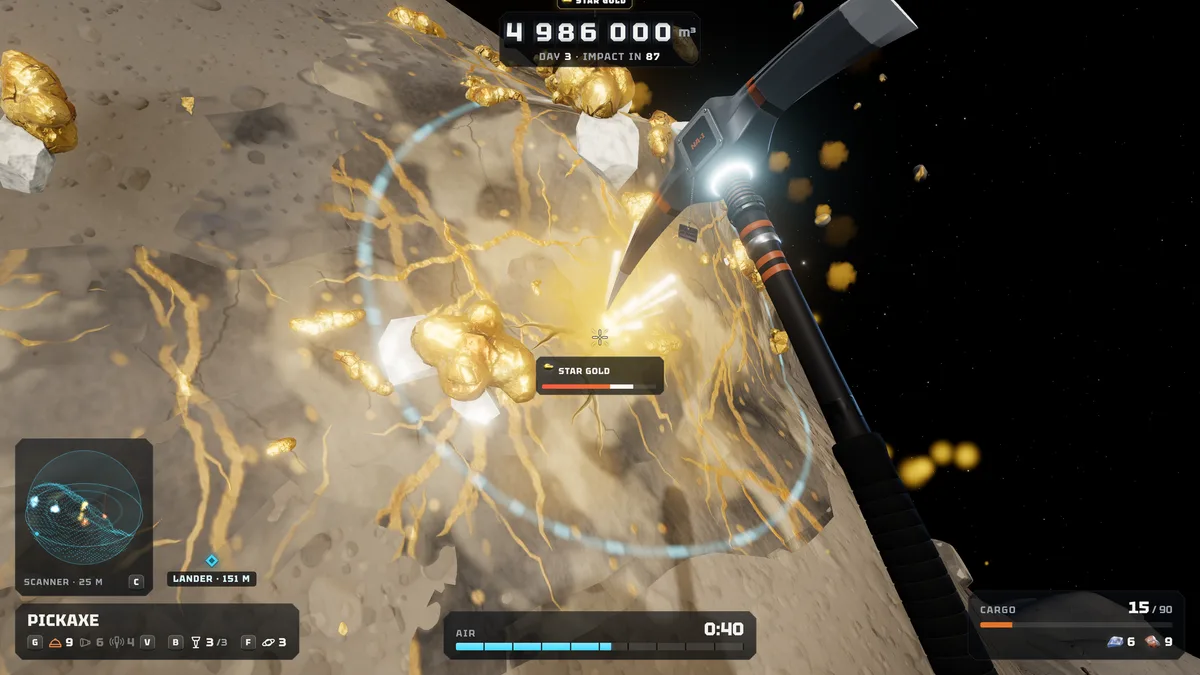
The game does not publish depths in metres, and there is no map overlay that grades rock by hardness. You read the layers from feel and from the scanner: the colour of the ore through the wall, how long a swing takes to bite, and how much rubble a cut leaves behind.
| Layer | What you find | Main risk |
|---|---|---|
| Surface | Soft stone, common ore, quick cuts | Almost none; the danger is staying here too long |
| Mid rock | Harder stone, mixed minerals, first real pockets | Tunnels that branch and become hard to retrace |
| Deep rock | Hard, slow cuts, the high-value minerals | Long return trip on a falling air bar |
| Core | A distinct centre layer, achievement territory | All of the above, compressed into one push |
| Loose debris | Floating chunks anywhere you have mined | Drift into your route or knock you off a ledge |
Is deep rock actually richer?
Yes, and the trade is deliberate. Rock gets harder and richer with depth, so every metre down costs more time and returns more value. That is the central tension of the game: the best ore is always one layer further than is comfortable.
The practical consequence is that depth should be bought, not attempted. A better tool turns a five-minute cut into a two-minute cut, which is what makes deep rock profitable rather than merely reachable. Going deep on a starting Pickaxe is how players discover that the air bar, not the rock, was the real limit.
What is at the core?
The core is the asteroid’s centre and a distinct layer in its own right. Reaching it earns Straight to the heart, which 64.4% of players had unlocked at the snapshot — a high figure that tells you most runs get there eventually, not that it is free.
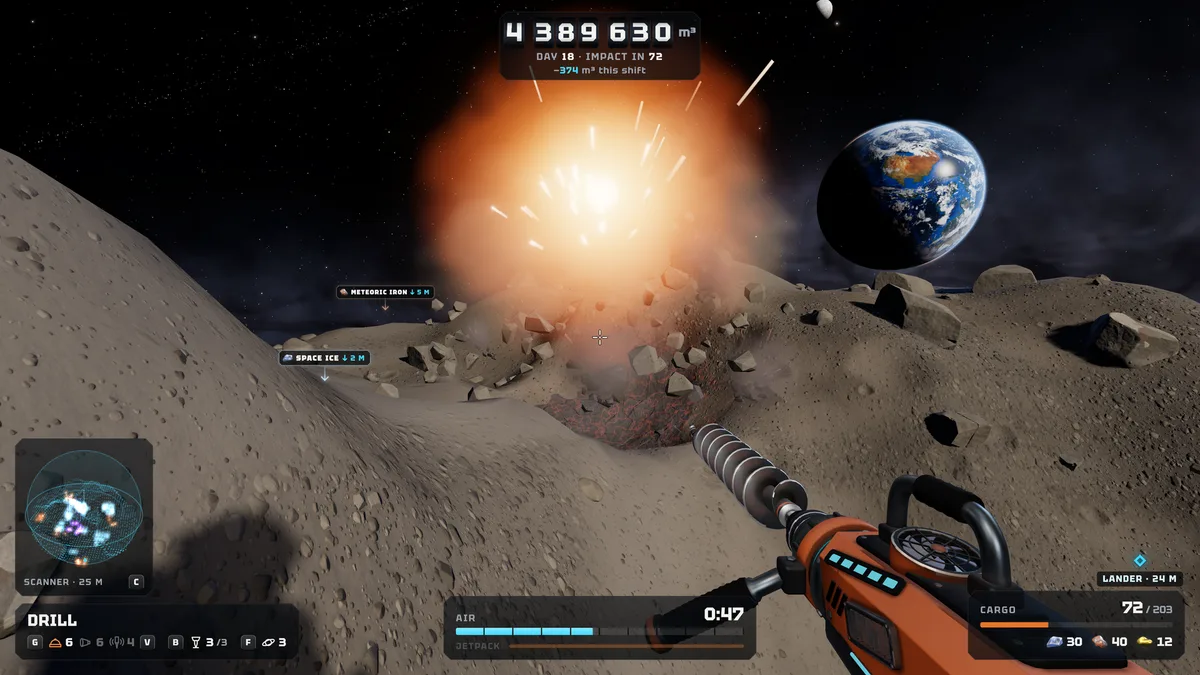
The core matters for two reasons beyond the achievement. It is the deepest and therefore the richest rock in the asteroid, so a dedicated push is where the value per cut peaks. And it is the point where the asteroid stops being a hole you are digging and becomes a shape you are carving, because the tunnels you cut on the way in are now the structure you have to keep stable on the way out.
If you are chasing the core, plan it as a dedicated trip rather than an extension of a normal shift. Go in light, take the shortest route you can defend, and accept a lower cargo return in exchange for the achievement and the samples.
What are the loose pieces?
Loose chunks break free as you mine and float in the low gravity. They are the asteroid’s most underrated feature: each one is ore you have already cut, sitting in front of you, waiting to be picked up rather than dug out of a wall.
They can also be ridden, which is what the Rock rider achievement (62.3%) rewards. A drifting chunk is a free platform, and in a deep shaft it can be a faster way down than walking. The same chunk becomes a hazard when it drifts into a tunnel you need to use, or when it carries you somewhere your air budget did not plan for.
Collecting loose pieces is nearly always worth a few seconds. They cost no cutting time, they fill cargo, and they clear the tunnel you are about to use. The one exception is a chunk that is visibly drifting toward your exit; let that one go and get out of its way.
How does the rock change as you mine it?
The asteroid is changed by your own work. Every cut removes structure, opens a pocket that may be pressurised, and creates a route that is now part of your commute. A face that was solid on the way in is a tunnel on the way out, and a tunnel is only useful if it is still passable.
Two changes matter more than the rest. First, mining can open gas pockets, which knock you back and cost air; the deeper and more aggressive the cut, the more likely you are to meet one. Second, the freely floating debris increases as you work an area, which makes the same tunnel harder to fly through on the return than it was on the way in.
That is why experienced players treat a shift as a sequence of decisions about the asteroid’s shape rather than a sequence of swings. The hazards guide covers what is waiting inside the pockets; the layer you are in tells you how likely you are to find them.
Why does a spiral route beat a straight shaft?
Because a straight shaft is a trap with good ore at the bottom. Community strategy is consistent on this point: do not dig a shaft you cannot walk out of, and prefer a spiral or ramp that keeps a navigable slope back to the surface.
A spiral costs a little more cutting than a plunge, and it buys three things. It keeps a continuous route to the lander that does not depend on the jetpack. It puts your cuts in fresh rock on the outside of the turn rather than re-cutting the same wall. And it makes the tether a backup rather than a plan: press R and you are pulled back toward the lander, but relying on that pull every trip is how players get caught short when the air bar is already low.
The mining routes guide turns this into a working method, including the air thresholds to respect on the way down. For now, the layer rule is simple: the deeper you intend to go, the more your route should look like a ramp and the less like a well.
What do custom asteroids change?
Custom Asteroids, added as a beta in 1.0.9, let you build your own layered rock. Under Mods, then New asteroid, you can load a GLB, GLTF, OBJ or STL file, set the name, size and appearance, and edit rock.json to define up to 16 custom materials with their own textures, hardness, layers and mineral deposits.
That last detail is the interesting one for this article: layers and deposits are authored properties, not something baked into a mesh. It confirms in the game’s own data model what the campaign teaches by feel — a layer is a band of rock with a hardness value and a mineral table attached. Four asteroids ship with the beta, and custom runs use separate saves from the campaign.
Which layer should you be working?
Work one layer below where you are comfortable, and only after your air and cargo can support the round trip. The surface pays for your first upgrades; mid rock pays for your tools; deep rock and the core pay for the endgame. Skipping a layer rarely works, because the equipment that makes deep rock efficient is bought with the money the shallow layers produce.
Use the scanner to check what is actually in front of you before you commit. Per-mineral colours and the ability to hide individual minerals, both improved in 1.0.2, turn a wall from a grey surface into a shopping list. The scanner and tether guide covers the toggles, and the tips list has the habits that keep a deep push from becoming a rescue.
What to do next: pick a single mid-rock pocket, map your route down as a spiral, and time the full round trip rather than just the dig. That number — minutes down, minutes back — is the budget every deeper trip has to fit inside. When you have it, the mineral price guide tells you which of the ores you just found is actually worth the flight.
Gallery
FAQ
How deep can you dig in No Asteroids?
Is deeper rock worth more in No Asteroids?
What is the core in No Asteroids?
Can you ride loose rocks in No Asteroids?
Related Articles
mining
No Asteroids Hazards: Gas, Antimatter and Strange Matter
The four things in the No Asteroids asteroid that can cost you a shift: gas pockets, explosive Antimatter, Strange Matter and the dark rock you see glowing.
mining
No Asteroids Minerals and Ore Prices: Full List
Every confirmed No Asteroids mineral, what each one is for, and the one-day terminal price snapshot — plus why those ore prices change daily.
mining
No Asteroids Mining Routes: How to Dig and Get Back
A practical No Asteroids mining route: plan the exit first, spiral instead of sinking a shaft, watch the one-third air rule, and know when to tether home.
Was this helpful?
Thanks for the feedback!