No Asteroids Minerals and Ore Prices: Full List
Every confirmed No Asteroids mineral, what each one is for, and the one-day terminal price snapshot — plus why those ore prices change daily.
No Asteroids does not publish an ore price list, because it does not have one. The trade terminal beside your lander re-prices every mineral each in-game day, and the only hard numbers we have come from an official screenshot of that terminal captured on one day of one build. Everything below is either that snapshot, a confirmed name from the game or patch notes, or a community-measured range. We say which is which.
How many minerals are there?
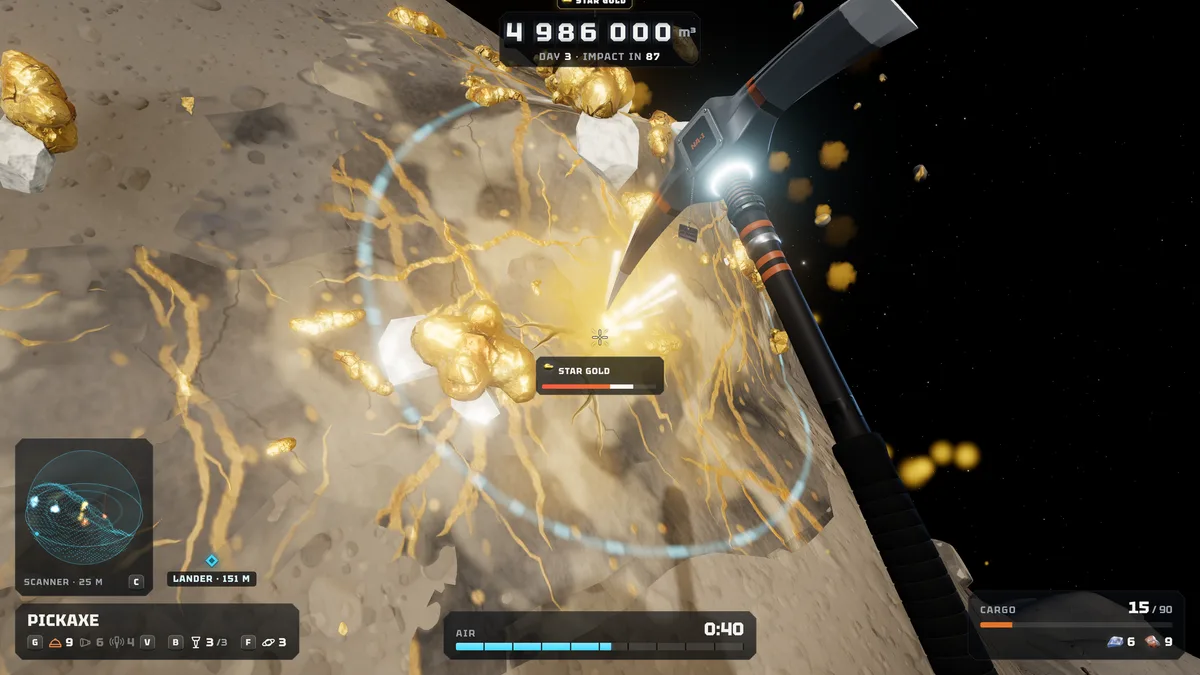
At least eight are mineable, which is the bar the Mineralogist achievement sets (76.2% of players at the time of writing). Eleven names are confirmed in the game’s own text: Spice, Meteorion Iron, Iron ingot, Gold, Spice crystal, Plasma, Antimatter, Neutronium, Dark matter, Strange matter and Ice.
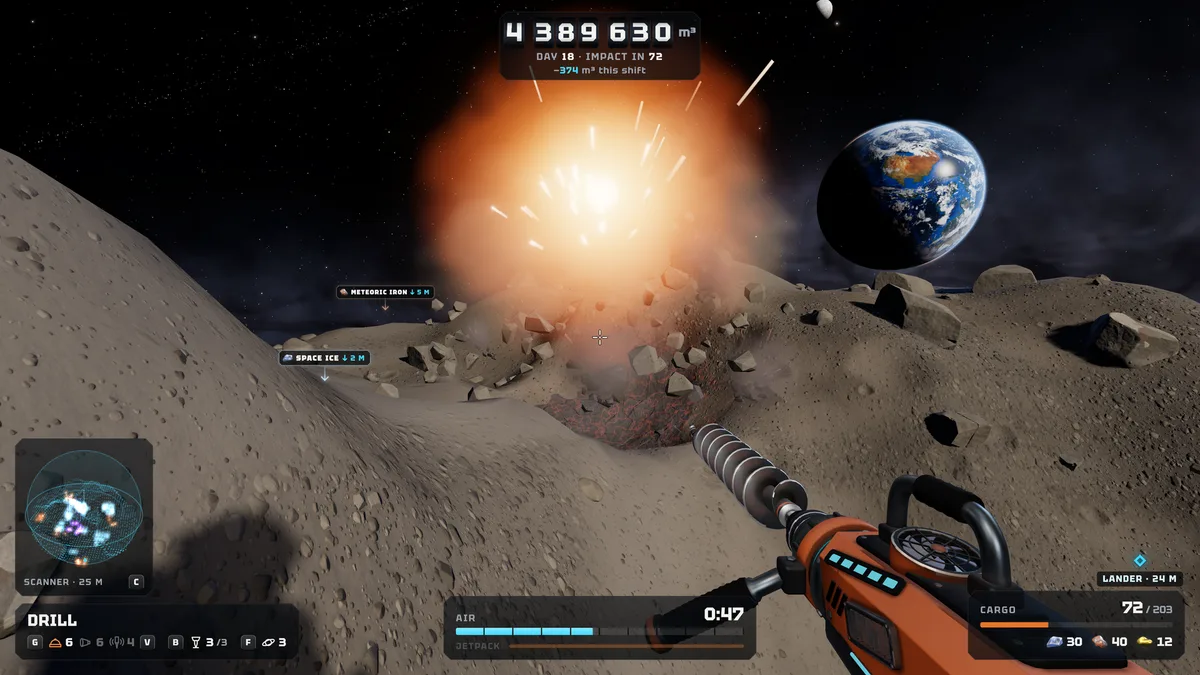
That gap between eight and eleven is not a contradiction. The achievement counts minerals you can actually dig, while the terminal lists everything that has a line item, including materials that arrive in small quantities or after a specific unlock. Two of the names, Meteorion Iron and Iron ingot, appear as separate stock on the terminal, so treat them as separate things to sell rather than assuming one converts into the other.
Which ores are worth the most?
Plasma is the highest-priced ordinary ore in the official terminal screenshot, and Antimatter and Neutronium are the two high-value special cases that behave differently from everything else. The table below groups all confirmed names by the job they do in a run.
| Mineral | Role in a run | What to know |
|---|---|---|
| Spice | Bulk ore, common early | Cheap per unit, but fills cargo fast and sells every trip |
| Meteorion Iron | Bulk ore, common early | The workhorse line on the terminal; reliable rather than rich |
| Iron ingot | Bulk ore, listed separately | Separate terminal entry from Meteorion Iron |
| Gold | Mid-value ore | Good filler between better finds; no special handling |
| Spice crystal | Mid-value ore | Higher-grade sibling of Spice on the same terminal screen |
| Plasma | High-value ore | Top of the ordinary price range in the official screenshot |
| Antimatter | High-value, dangerous | Explodes if cut with a hand tool or drone; see below |
| Neutronium | High-value, late | Prices were adjusted in 1.0.3; check the terminal before a big haul |
| Dark matter | Loose, glowing find | Glows in the rock, clearly visible since 1.0.2 |
| Strange matter | Special, blast-proof | Survives an Antimatter blast; tied to the 1.0.5 asteroid heart |
| Ice | Bulk, low value | Common filler; useful for cargo volume, not for income |
Reading that table as a shopping list is the mistake. Value per unit is only half the maths; the other half is how much of the stuff you can carry and how far you have to fly to find it. A hold full of Spice beats three units of Plasma on most early days, which is why the selling ore guide treats cargo turnover as the real income driver.
What were the terminal prices on the snapshot day?
These are the six line items visible in the official trade screenshot, taken on one in-game day in build 1.0.9. They are a snapshot, not a price list.
| Ore | Price per unit (snapshot) |
|---|---|
| Spice | 900 |
| Meteorion Iron | 1,000 |
| Iron ingot | 900 |
| Gold | 700 |
| Spice crystal | 900 |
| Plasma | 1,300 |
Two things about that table are worth noticing. First, Gold sits below Spice and Iron, which cuts against the instinct that the shinier name is the better sale. Second, none of these values are rounded to a suspiciously clean number, which is what a live market looks like.
If you want a current figure, the only reliable method is to look at your own terminal before you commit a hold to a sale. That is also the moment to check the daily order, which pays a bonus on one specific mineral — the official screenshot shows a 26,544 payout on a day-20 order, which is large enough to be worth steering a shift around.
Why is Antimatter priced in a range?
Because Antimatter is the one mineral whose price is reported as a band rather than a number. Community tracking puts sales at $113 to $202 per unit in the launch build. The band is wide because Antimatter obeys the same glut rule as everything else, and it is the mineral most likely to be dumped in bulk by a crew that has just cracked a pocket open safely.
Antimatter is also the only ore that punishes the wrong tool. Cut it with a hand tool or a drone and it detonates: community-measured 3.4 m blast, roughly eight seconds of air lost if you are inside it, and the ore around it destroyed rather than collected. Break it with a charge, a singularity, a mining rig or a ship gun and it drops cleanly with no blast at all. Our hazards guide covers the safe methods in detail; the short version is that Antimatter is a mining problem before it is a pricing problem.
What is the glut threshold?
Dumping too much of one mineral into the terminal lowers its price. The community-measured threshold for Antimatter is 800 units, and the same behaviour is reported across the market. Selling in smaller batches, or spreading a big haul across two days, is the usual workaround.
There is a tension here with the advice to sell every trip. The resolution is that glut only bites on genuinely large volumes: a normal day’s hold is nowhere near 800 units of one mineral, so routine selling is unaffected. Glut becomes real when you have spent three days stockpiling a single high-value ore and then sell it in one go.
Does refining beat selling raw ore?
Refining pays more than a straight sale. The official terminal screenshot shows a +19% refine uplift on the sell-all button, which is why the refine option is worth taking on almost any haul you are not in a hurry to convert. The exception is a daily order: if the order names a mineral you are carrying, compare the order bonus against the refine uplift before you press anything.
The uplift is a percentage, so it scales with whatever the day’s price happens to be. That makes refining a multiplier on a moving number rather than a fixed bonus, and it makes a high-price day the best time to refine a backlog.
What about ordinary rock after day 35?
From day 35, ordinary mined rock fills spare cargo and sells for $2 per unit, a change added in update 1.0.2. Mineral cargo still takes priority, so the rock is strictly a use for the space you would otherwise fly home empty.
Two dollars a unit is not a reason to dig rock on purpose. It is a reason not to launch with empty slots once the rule is live, and it softens the post-core plateau that players complain about in the back half of a run. Before day 35, rock is dead weight and should stay on the asteroid.
Which minerals should you actually chase?
Chase volume first, value second, and let the daily order break the tie. In the first ten days that means Spice and Meteorion Iron, because they are common, they fill a hold quickly and they sell every trip. Once your cargo and air upgrades are in, shift the mix toward Plasma and the two dangerous high-value ores.
Keep a mental note of what you are leaving behind, too. The asteroid layers guide explains why the richer ores sit deeper, and the mining routes guide covers how to reach them without spending your air on the way back.
What to do next: take one shift and sell everything at the terminal without refining, then repeat the same haul with refine on and compare the two payouts. That single experiment teaches you more about the market than any price table, because it shows you what the uplift is worth on your own cargo. When you are ready to turn ore into a plan, read the achievements list and note how many of the mining milestones are about variety rather than volume.
Gallery
FAQ
How many minerals are in No Asteroids?
How much is Antimatter worth in No Asteroids?
Do ore prices change every day in No Asteroids?
What is the fastest-selling ore in No Asteroids?
Related Articles
guides
No Asteroids 90 Days Guide: How the Clock Really Works
How the No Asteroids 90-day contract works: what the counter measures, which actions spend a day, a ten-day spending plan and how to fix a run that is behind.
guides
No Asteroids Selling Ore: Terminal, Refine and Daily Orders
How selling ore works in No Asteroids: the terminal beside the lander, the refine uplift, daily orders, glut, and when to sell every trip or bank a haul.
guides
No Asteroids Tips: 15 Habits That Save In-Game Days
Fifteen No Asteroids tips that actually save time: quarter-bar returns, cargo before speed, daily bonuses, gun timing and the habits that prevent blackouts.
Was this helpful?
Thanks for the feedback!